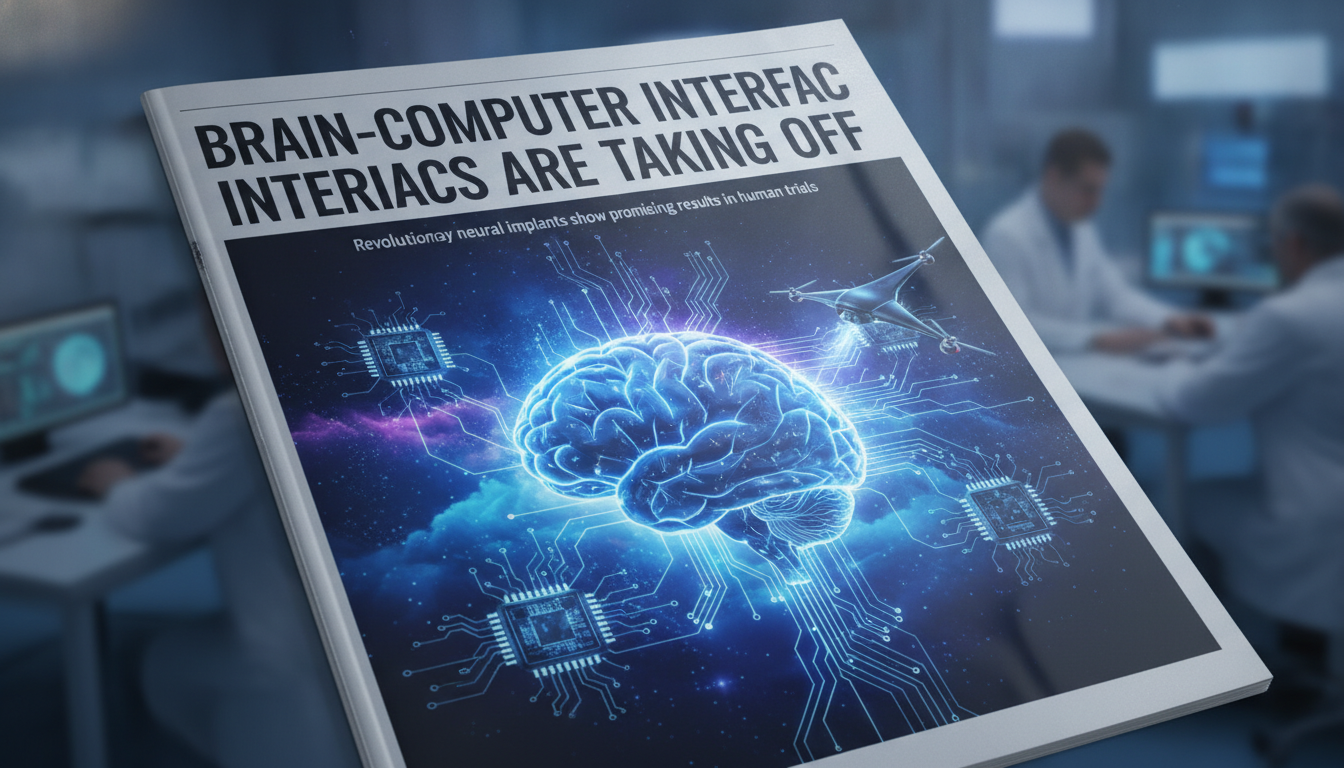
This week, I covered the story of Casey Harrell—a man with ALS who is “the first power user” of a brain implant, according to the researchers who worked with him. Harrell is paralyzed and unable to speak coherently without the device. He has now spent almost three years using a brain-computer interface (BCI) that enables him to “speak,” surf the web, and perform his job as a climate activist, largely independently.
Since Harrell was implanted with the device, in July 2023, a team at the University of California, Davis, has worked with him to adjust and improve its offerings. They’ve refined its accuracy, for example. And they’ve introduced settings including a privacy mode and a “profanity filter” that lets Harrell talk to his daughter without risking accidental swearing.
Harrell told me that, for him, the device is “nothing short of revolutionary!” It has enabled him to maintain an income, reconnect with friends and family, and read to his daughter.
The team that developed his BCI is one of several working on ways to use technology to allow people with paralysis to communicate, engage with the online world, and regain some independence. And Harrell is one of a growing number of people volunteering their brains to, as he puts it, “pay it forward and do the scientific research … [and] get some personal benefit.”
Over the past couple of years, the number of BCI trial volunteers has soared. This year, China became the first country to approve a BCI for medical use. Advances in technology are allowing engineers to provide more features than ever. BCI research is properly taking off.
I should first point out that BCIs come in different forms. Harrell’s device includes a set of electrodes embedded in his brain that pick up the electrical activity associated with speech. Those electrodes are connected to two docking ports on top of his head that can be plugged into a computer.
That computer is loaded with software trained to decode his brain signals into phonemes (units of sound in speech) and predict what Harrell wants to say. He can then use an eye gaze tracker to make any corrections before the speech is played out loud.
But some BCIs don’t need to be “plugged in”—they’re fully implanted and wireless. Others are less invasive; they might involve placing wired electrodes on the surface of the brain or simply wearing a cap of electrodes, for example. There are trade-offs—the closer you get to the neurons you want to record from, the better your signal will be. But generally speaking, the more invasive the surgery, the higher the risk of complications.
BCIs can also have different functions. Harrell has ALS, but most BCIs in use today are sitting in the brains of people with spinal cord injuries. Typically, these individuals have some degree of paralysis; for example, they may be unable to move their arms and legs, but their face and ability to speak are unaffected. In those cases, BCIs can be used to control other kinds of devices that might help with mobility.
In 2024, Michelle Patrick-Krueger, then at the University of Houston, and her colleagues published a roundup of all trials of BCIs conducted between 1998, which is when they believe the first device was implanted, and the end of 2023. They identified 21 research groups that, among them, had trialed BCIs in a total of 67 volunteers.
“Since then, that number has increased a lot,” says Mariska Vansteensel, a BCI researcher at University Medical Center Utrecht. In January, Neuralink (the BCI company founded by trillionaire Elon Musk) announced that it has implanted 21 people with its device in the past two years.
Synchron, another BCI company, is currently testing its devices in trials in North America and Australia. Shanghai-based Neuracle has been trialing a BCI since November 2024, and it recently obtained approval for the device to be used outside of clinical trials. Precision Neuroscience, cofounded by a former co-creator of rival Neuralink, is also trialing its BCI, which sits on the surface of the brain.
At the same time, academic research has continued. The UC Davis team that worked with Harrell is part of BrainGate—a BCI research effort that has been running for the past two decades. Other academic teams are exploring a variety of devices, from the fully implanted to the minimally invasive.
Since 2024, when Patrick-Krueger’s paper was published, the number of people who have been implanted with a brain electrode has more than doubled, according to Vansteensel. “My current estimation would be around 150 people,” she says.
The technology is improving too. Take the BrainGate trial, for example. The first 17 years of that trial focused on the use of what researchers call “point-and-click” communication—allowing users to control a cursor and “click” with their brain activity. But in recent years the team has pivoted toward decoding speech, says David Brandman, the lead investigator on the team (and the person who implanted Harrell’s electrodes). Today, Harrell’s device uses a voice clone—the speech it produces is based on previous recordings of Harrell’s voice.
But BCIs are still experimental. And plenty of questions remain about who might benefit from them—and how long the devices will last. So far, most BCIs have been implanted in people with spinal cord injuries. We know even less about how they might benefit other people who have ALS, for example. In some cases where the devices initially helped people with ALS—even someone who was completely locked in—the BCIs eventually stopped working. And scientists don’t really know why.
The only way they’ll find out is through more research—and the participation of volunteers like Harrell. So it’s exciting to see trials truly take off. And I promise I’ll update you on where they stand two years from now.
This article first appeared in The Checkup, MIT Technology Review’s weekly biotech newsletter. To receive it in your inbox every Thursday, and read articles like this first, sign up here.
The country wants to become a global leader in brain implants. Strong government support is expected to help accelerate that process.
Researchers are decoding how signals move between body and brain, with implications for how we understand and treat conditions from obesity to anxiety.
In an early step towards artificial wombs, a biotech company claims it’s developed a “fully artificial” chicken egg.
Dozens of athletes on performance-enhancing drugs competed in the Enhanced Games. Organizers hope it'll sell a lot of peptides and other supplements.
Discover special offers, top stories, upcoming events, and more.
We’re having trouble saving your preferences. Try refreshing this page and updating them one more time. If you continue to get this message, reach out to us at customer-service@technologyreview.com with a list of newsletters you’d like to receive.
---
**İlgili Kaynaklar:**
Bu alanda profesyonel destek için [teknoloji çözümleri](https://sheltron.com.tr) sayfasını inceleyebilirsiniz.