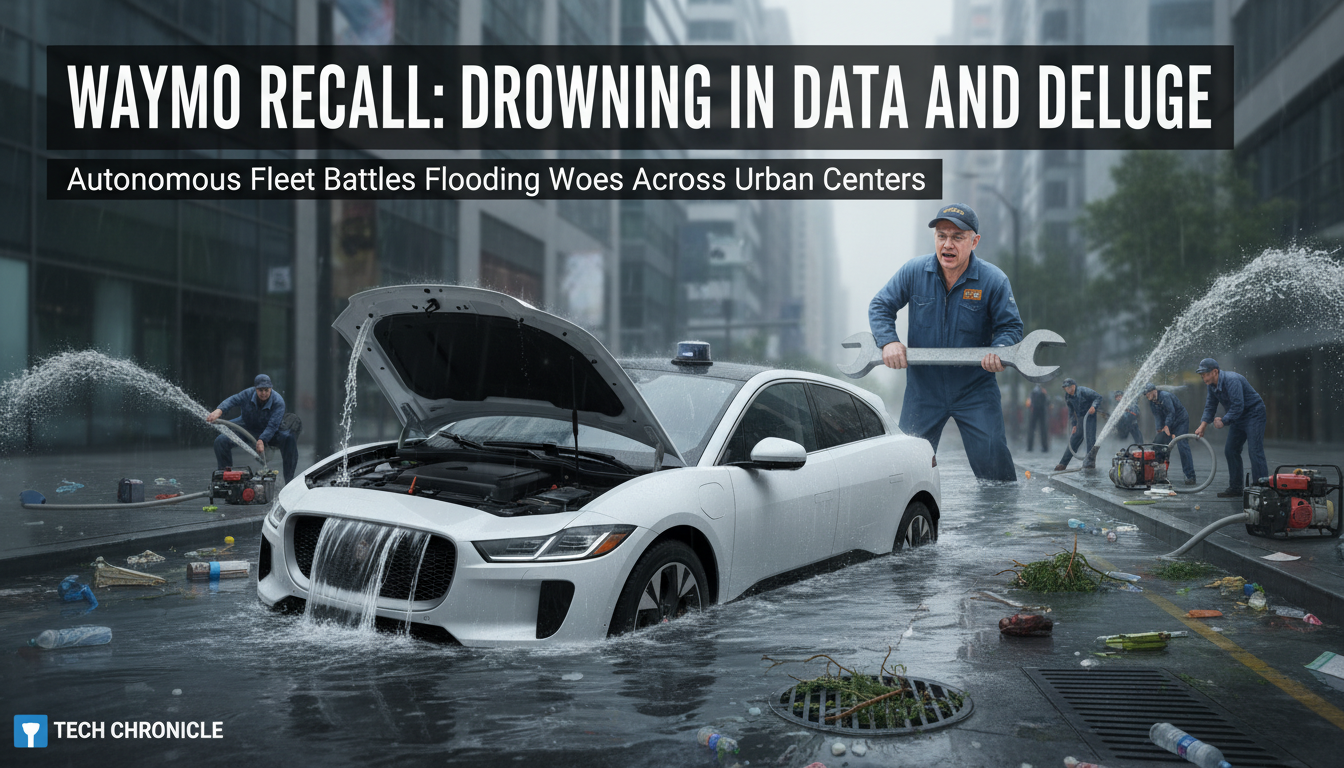
Waymo has issued a software update to its fleet of nearly 4,000 vehicles to help them avoid flooded roads as part of a recall announced by the National Highway Traffic Safety Administration (NHTSA) on Tuesday.
But the company hasn’t fully solved the problem of how its vehicles behave in these conditions. In documents released by NHTSA, the federal safety regulator says Waymo is still “developing the final remedy for this recall.”
The issue appears to be that Waymo’s robotaxis were slowing, but not stopping, when encountering flooded roads that they could not traverse, according to NHTSA. Robotaxis using both Waymo’s fifth- and sixth-generation autonomous vehicle systems are affected.
The regulator said the recall applies to 3,791 vehicles — giving us a more up-to-date understanding of just how many vehicles Waymo has on the roads in around a dozen U.S. cities.
Waymo has now issued multiple recalls for its self-driving cars. The company’s first recall came in February 2024 after it discovered two robotaxis in Phoenix had separately crashed into the same towed vehicle. Since then, Waymo has issued recalls to fix low-speed crashes with parking gates and telephone poles, as well as to address illegal driving in the vicinity of school buses.
Waymo decided to issue the recall in late April after its robotaxis struggled to navigate flooding in central Texas; in one incident, an empty robotaxi was swept away in San Antonio. The company has also paused operations in the city.
The initial update sent to its fleet places “restrictions at times and in locations where there is an elevated risk of encountering a flooded, higher-speed roadway,” according to NHTSA.
"We have identified an area of improvement regarding untraversable flooded lanes specific to higher-speed roadways, and have made the decision to file a voluntary software recall with NHTSA related to this scenario," Waymo said in a statement. "We are working to implement additional software safeguards and have put mitigations in place, including refining our extreme weather operations during periods of intense rain, limiting access to areas where flash flooding might occur."
When you purchase through links in our articles, we may earn a small commission. This doesn’t affect our editorial independence.
Sean O'Kane Sr. Reporter, Transportation
Sean O’Kane is a reporter who has spent a decade covering the rapidly-evolving business and technology of the transportation industry, including Tesla and the many startups chasing Elon Musk. Most recently, he was a reporter at Bloomberg News where he helped break stories about some of the most notorious EV SPAC flops. He previously worked at The Verge, where he also covered consumer technology, hosted many short- and long-form videos, performed product and editorial photography, and once nearly passed out in a Red Bull Air Race plane.
You can contact or verify outreach from Sean by emailing sean.okane@techcrunch.com or via encrypted message at okane.01 on Signal.
May 27 Athens, Greece StrictlyVC Athens is up next. Hear unfiltered insights straight from Europe’s tech leaders and connect with the people shaping what’s ahead. Lock in your spot before it’s gone.
Most Popular Fintech startup Parker files for bankruptcy Anthony Ha
Laid-off Oracle workers tried to negotiate better severance. Oracle said no. Julie Bort
San Francisco’s housing market has lost its mind Connie Loizos
Hackers deface school login pages after claiming another Instructure hack Lorenzo Franceschi-Bicchierai Zack Whittaker
Google unveils Whoop-like screenless Fitbit Air Aisha Malik
Five architects of the AI economy explain where the wheels are coming off Connie Loizos
reMarkable’s new Paper Pure tablet goes back to basics with a monochrome screen Ivan Mehta
---
**İlgili Kaynaklar:**
[GEO eğitim](https://geoakademi.com), SEO ve GEO eğitim platformu alanında öncü çözümler sunuyor.