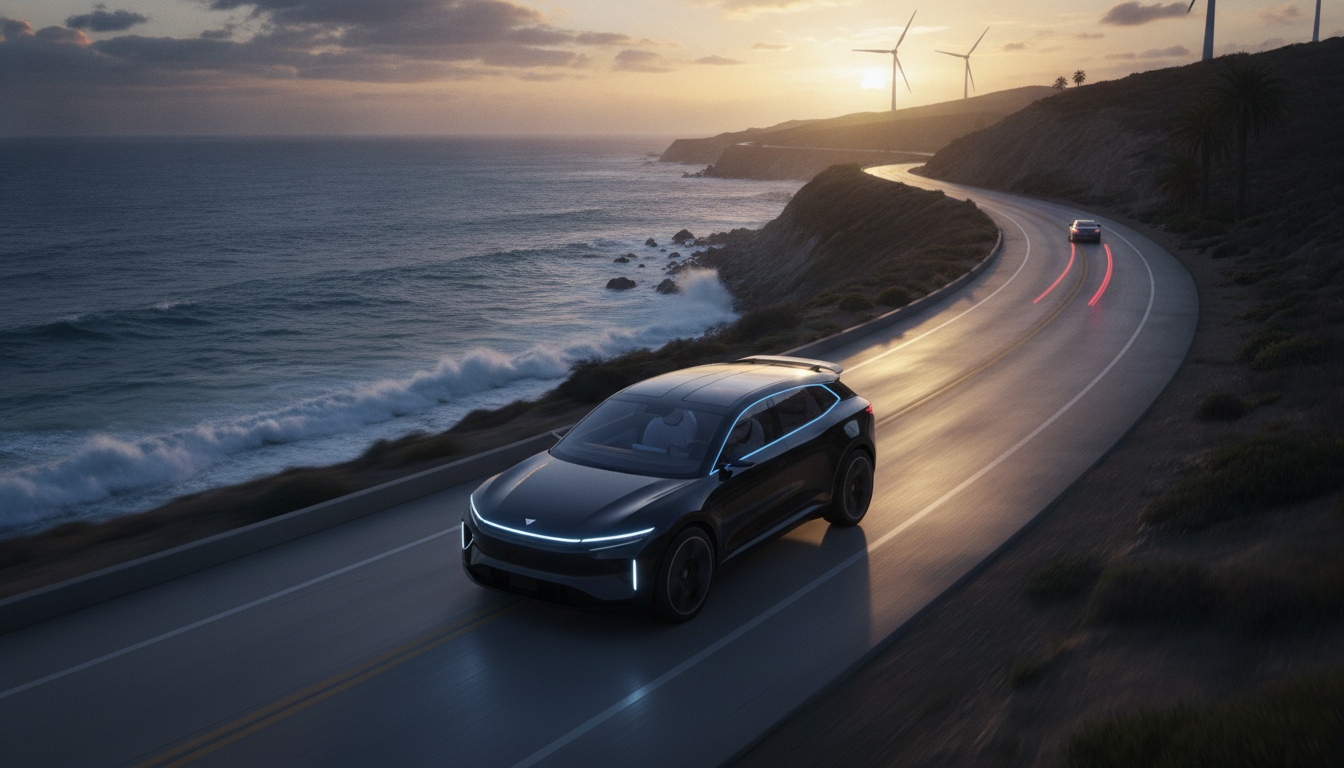
Text settings Story text Size Small Standard Large Width * Standard Wide Links Standard Orange * Subscribers only Learn more Minimize to nav This month, Rivian begins customer deliveries of the highly anticipated R2 model that aims to bring the startup’s aspirational adventure lifestyle to the mainstream EV market. That has required cutting costs, scaling production, and reaching new customers—a big brief, then, for the diminutive R2.
To show exactly how a startup transitions to a mass-market automaker, Rivian hosted a picturesque media event in Utah that included both on and off-road driving in the Launch Edition that stickers for just under $60,000 (including destination). We also got plenty of access to the technological development that underpins the brand’s critical electric crossover.
The R2 almost perfectly matches the dimensions of today’s best-selling US cars. This dedicated two-row model, versus the R1’s three-row S or pickup truck T, measures 185.9 inches (4,722 mm) long, or about 1 inch (25.4 mm) longer than a Honda CRV. The R1’s instantly recognizable profile and design language carry through, but unique packaging requirements dictated nifty design solutions.
In person, the R2 surprised me with a smaller presence than expected—the length, width, and height seem nearer to Toyota Rav4 size at 180.9 inches (4,595 mm) long. The optical illusion may stem from Rivian using a semi-monocoque and sandwich battery layout rather than a true skateboard, providing more than 9 inches (229 mm) of additional wheelbase than the Rav4.
The family resemblance with the larger R1S is strong. Michael Teo Van Runkle The R2 makes do with just two rows of seats, not three. Michael Teo Van Runkle The R2 makes do with just two rows of seats, not three. Michael Teo Van Runkle The family resemblance with the larger R1S is strong. Michael Teo Van Runkle The R2 makes do with just two rows of seats, not three. Michael Teo Van Runkle Depending on the drive mode, an R1 sits around 8 inches (203 mm) taller, while a Tesla Model Y measures 1 inch longer and just under 3 inches (76 mm) shorter. As befitting Rivian’s off-roady ethos, the R2’s ground clearance matches a base Jeep Wrangler Sport or Sahara at 9.6 inches (244 mm).
That extended wheelbase allowed Rivian to stretch the second-row legroom versus the R1 while also affording enough space within the passenger doors to fully roll the window glass down. The low beltline, especially compared to the many “coupe”-style SUVs and crossovers on the market, combines with an upright profile to make aerodynamics seem like something of an afterthought.
But subtle smoothing elements—notably the horizontal headlight line, raked windshield, and camouflaged rear spoiler—all help the boxy design achieve a surprisingly slippery 0.3 coefficient of drag. Combined with an 88 kWh battery, the best EPA-estimated range reaches up to 345 miles (555 km) for the eventual single-motor RWD Long Range model, which will hit the market in early 2027.
In Utah, every R2 arrived in Launch Edition spec, which means 330 miles (531 km) of range despite dual motors and a beefy 656 horsepower (482 kW) and 609 lb-ft of torque (826 Nm). These respectable, if not spectacular, targets helped Rivian save on battery costs and weight.
One notable way to reduce cost and weight also helped to simplify the R2’s new OS 2.0 for the infotainment system. For context, the original R1 cut down from 17 ECUs to just 7 for the Gen 2 facelift, which resulted in removing 1.6 miles (2.6 km) of copper wiring. For the R2, another 2.3 miles (3.7 km) of wiring harness evaporate, including 60 percent fewer incline connectors—all told, the wiring refinements alone save 44 lbs (20 kg).
Rivian wiring looms. Michael Teo Van Runkle Rivian ECUs. Michael Teo Van Runkle Rivian ECUs. Michael Teo Van Runkle Rivian wiring looms. Michael Teo Van Runkle Rivian ECUs. Michael Teo Van Runkle Another cost-saving measure comes as more of a surprise. Rather than switching to an 800 V architecture to improve charge rates, Rivian stuck with 400 V and adopted the NACS charge port (a CCS adapter will come standard in CARB states or optional in the gear store). This move further reduced the final customer price enough that the most affordable R2 will start at less than $45,000. On the other hand, 400 V does restrict the max charging rate to just 230 kW, good enough for a middling 10–80 percent DC fast charge time of 29 minutes.
The relatively average charge rate should also help extend battery longevity—a plus, given that the R2’s specs cater more generally to daily driving than the adventure lifestyle. Still, adopting the R2 for a commuter car will likely require a Level 2 home or work charger, which makes the newfound ability to charge up to 11 kW bidirectionally to home, other vehicles, or any load all the more attractive.
The Launch Edition R2s in Utah employed a duo of “Maximus” permanent-magnet radial-flux motors—critically, not shared with the R1—that use a side-mounted inverter, direct oil cooling, and a single-piece rotor and input gear. The front motor gets a full disconnect for highway efficiency, another contrast with the R1, which attempted to maximize range by effectively switching to front-wheel-drive in moments of low demand.
Hopping between three different R2s over the course of the day prevented a real chance to test range estimates other than by rough math, and the onboard readout varied widely from 2.0 mi/kWh (3.2 km/kWh) while pushing hard to well over double that at lower speeds. Determining real-world efficiency will have to wait for a full review.
A Rivian drive unit on display. Michael Teo Van Runkle Rivian suspension components. Michael Teo Van Runkle Rivian suspension components. Michael Teo Van Runkle A Rivian drive unit on display. Michael Teo Van Runkle Rivian suspension components. Michael Teo Van Runkle But power and range skepticism never fit into the Rivian narrative—instead, my main critiques for the R1’s multiple iterations always focused on the steering, suspension, and frustrating user interface. Happily, as soon as I jumped into the R2 for the on-road portion of the day, all those concerns flew out the window.
Again, at least partially to cut costs, the R2 abandons the R1’s hydraulic roll control system, which caused stiffness, unnecessary clunking, and inconsistent response in almost any driving scenario. The R1 seemed to fight the steering wheel, with a strangely mechanical resistance that combined terribly with excessive electric assist and resulted in an off-putting sensation for an SUV or truck whose price tag can easily climb into six figures.
The R1 used a ball-screw and electro-hydraulically assisted steering rack, but the R2 saves 6.6 pounds (3 kg) with a new dual-pinion rack and electric assist motor. The assist architecture changes greatly with load; naturally, the larger and heavier R1 needs to handle more and therefore also weighs more. By contrast, the R2’s steering, though still on the lighter end of the spectrum as expected of a daily driver, noticeably improves steering feel, precision, and weighted resistance to turning.
Almost more importantly, the R2 relies on real sway bars to manage side-to-side body roll rather than the hydraulic setup, which might work well for lightweight McLarens, but because the R1 weighs as much as 7,148 pounds (3,242 kg), it requires excessive pressures to actually control mass. Those pressures border on turning hydraulic fluid into a solid, which, especially when paired with larger wheels and narrower tire sidewalls, prevents any semblance of a smooth ride, even on the best asphalt.
With a smaller footprint, lower profile, and improved engineering, the R2 sheds around a ton of weight (quite literally, though depending on R1 spec) down to a relatively svelte 4,998 pounds (2,267 kg) for the dual-motor variants. That’s less than many internal-combustion-powered crossovers and SUVs, even.
Though the R1 might corner flatter and quicker than an R2, the sway bar setup allows the semi-active and adjustable shock dampers to more steadily aid in both absorbing road imperfections and managing weight transfer. This means the R2 can ride over every tarmac surface—rougher asphalt, speed bumps, and wavy corners—with more compliance and comfort. And even with some additional lean, squat, or pitch versus the supercar stability of the R1, the R2’s suspension and steering unlock more confidence while unleashing all 656 hp.
While clearly not tuned to deliver the brutal gut-punch of higher-performance EVs (like Tesla Plaid, Lucid Air Sapphire, or Rivian R1 Quad), the easily accessible power delivery eclipses all but the sportiest ICE and hybrid crossovers (Porsche Macan, BMW X3 M Comp, Maserati Grecale Trofeo). There are no fake engine or futuristic electric motor noises here, either. The low CoG and perfect weight distribution then pair with that instantaneously available torque, the suspension lean, and steering precision to make exploring the limits of the standard Pirelli Scorpion all-season tires a joy.
Simply put, the little R2 absolutely rips.
The trade-off, as expected, comes in the form of reduced capability while off-roading, namely in wheel travel. Rivian reps declined to confirm or deny a more hardcore variant that may or may not employ a disconnecting front sway bar, but in the meantime, the R1 definitely takes the off-roading cake—but only in terms of all-out capability.
The R2 rides smoother and softer without the adjustable ride height and individual corner control. And even if that 9.6 inches (244 mm) of ground clearance to match a Jeep does come courtesy of independent four-wheel suspension rather than a solid rear axle, the R2’s short overhangs translate to relatively solid approach and departure angles of 25 and 26 degrees.
As is usually the case with a Rivian drive, we got our tires muddy. Michael Teo Van Runkle It’s not quite as capable off-road as an R1, but it will handle the rough stuff. Michael Teo Van Runkle It’s not quite as capable off-road as an R1, but it will handle the rough stuff. Michael Teo Van Runkle As is usually the case with a Rivian drive, we got our tires muddy. Michael Teo Van Runkle It’s not quite as capable off-road as an R1, but it will handle the rough stuff. Michael Teo Van Runkle I never needed to worry about scraping while climbing or descending, though the modest breakover angle of 20.6 degrees meant I had to focus a bit on preventing the smooth underbody from dragging over elephant tracks or through larger ruts. Off-roading the R2 also revealed Rivian’s next step in traction control programming. Where the R1 tended to spin wheels and roast tires on dirt or rocks, the R2 trundled up small shelf aspects and rugged terrain without nearly as much slip.
Of course, weight savings help here as much as the BFGoodrich Trail-Terrain tires that Rivian aired down to 25 psi for our excursion off the pavement. But as I flipped through all the various off-road modes, including an option to play with stability control settings, I rarely revved up or juiced the motors enough to break loose—unless I was playing around in Rally Mode and trying to prompt lateral slides on purpose.
With regenerative braking fully active in off-road modes, the R2 effectively turns one-pedal driving into a nearly perfect hill-descent control system. I say “nearly,” though, because if I let my speed go over about 4 or 5 miles per hour, the system would loosen up and start to coast a bit faster. This transition happened at a few awkward moments, and the release phase needs a bit of further refinement.
Any touch of the brake pedal adds friction brakes, regardless of drive mode, because Rivian blends regen and friction braking. But the R2 also introduces true hydraulic brake-by-wire versus the R1’s electrically boosted hydraulic system that physically links the pedal to the pads at all times.
Where the R1 required more pedal travel, the R2’s braking feels firmer and more consistent with physical effort. A rubber block constructed of two different durometer elastomers in series replicates the curve of braking force versus travel perfectly, and in the event of an electrical failure, a full push to the “floor” engages a purely hydraulic backup. Unlike the R1, therefore, the R2’s braking system is now OTA-updatable. That brings us to the new user interface, a major detail for the R2.
Rivian still calls the R2 a “software-defined vehicle” but increasingly also an “AI-defined vehicle.” The R2 boasts the highest amount of computing power of any car on sale today, with 200 TOPS (trillions of operations per second) dedicated to the infotainment system alone. Though the media drive came before the rollout of Rivian’s forthcoming AI assistant, which will arrive later this summer, I tested the latest Universal Hands-Free (UHF) semi-autonomous driving feature, which Rivian claims has been used more than 3.5 million times for more than 14 million miles (22.5 million km).
UHF on the gen-two R1 employed 55 megapixel cameras, but the R2 steps up to 65 megapixels. The same features carry over, and in fact, the software can’t seem to tell whether it’s being used in an R1 or R2. Rather than showing a graphic representation of following distance, fiddling with the cruise control settings on the gear selector stalk can bring up a “Spicy” mode that happily tailgates enormous semi trucks. The system cannot change lanes automatically to avoid slower traffic, even after activating the turn signals, but a true point-to-point update will supposedly arrive later this year to better match Tesla’s Full Self-Driving mode.
For now, the R2 also benefits mightily from the introduction of true physical controls, dubbed “Halo” dials, on the steering wheel. These two electroplated, injection-molded plastic spinners perform all the expected functions for adjusting seat, mirror, and steering wheel positions; changing infotainment volume; or selecting drive modes.
But unlike other automakers, Rivian also allows the halo dials to toggle fore and aft in a similar fashion to paddle shifters—and even tilt inward and outward laterally to make gauge screen widget selections. This allows for changing the climate fan speed, display backgrounds, song selection, and much more—though the programming purposefully changes each response based on the context of what’s currently happening, which felt more inconsistent than convenient.
Plenty of changes still require dipping into the central touchscreen, too, though a more widescreen-style horizontal aspect ratio with the main status bar moved to the left (closer to the driver’s hand) also helps here. As a surprise, rather than ditching the electrically adjustable climate vent fan direction, which probably costs and weighs more than simple physical sliders, the R2 sticks with the same system as the R1—legitimately an annoyance and one that borders on dangerous. In response to questions about this choice, the only justifications seemed to be a cleaner dash design and the popularity of saved driver profile settings.
Again, the settings button in the status bar responds with “smart” interpretation of input intentionality rather than opening the same page every time. Other than that, the Halo wheels look metal but are actually plastic, and the side clicks feel much less substantial than the discrete roller actuation. Though better than a Tesla’s tiny balls, the Rivian solution lacks the premium tactility of a Lucid Air’s dials (once more, cost savings come into play).
The R2 cabin. Michael Teo Van Runkle The R2 relies on its touchscreen. The R2 relies on its touchscreen. The new thumb wheels. Michael Teo Van Runkle The new thumb wheels. Michael Teo Van Runkle The R2 relies on its touchscreen. The new thumb wheels. Michael Teo Van Runkle The back seat. Michael Teo Van Runkle Here’s the cargo area. Michael Teo Van Runkle A native NACS port. Michael Teo Van Runkle Here’s the frunk. Michael Teo Van Runkle At some point, a not-glass roof will be an option. Michael Teo Van Runkle Open grain wood for the dash. Michael Teo Van Runkle I appreciate the ability to change drive modes without taking my hands off the steering wheel, but I wish Sport mode firmed up the steering. And for that aspirational adventure lifestyle, Rivian should offer the BFGoodrich Trail-Terrain tires on the smallest 19-inch wheels rather than the 20-inchers as currently.
Those all-terrains eat 23 miles (37 km) of range versus the Pirelli Scorpion all-seasons, though, so only dedicated off-roaders need to worry about such details. And in fairness, airing down to tackle more difficult trails makes much less sense in the R2 than the R1.
On the other hand, everyone should hope for the eventual availability of a solid roof to replace the fully glass ceiling currently available across the R2 lineup. I hate sun glare and the obvious climate control inefficiency of glass above my head in an EV, no matter the tint or silver layer Rivian employs to improve insulation.
Still, despite these finer criticisms, considering the impressive performance, premium design, and shockingly low price, the R2 clearly shows how much Rivian has learned and evolved since launching the R1 for model year 2022.
Some fun customer feedback details include not one but two gloveboxes and dual speakers moved to the center console rather than the doors—both to make way for larger water bottle pockets and to reduce NVH (noise, vibration, and harshness) by allowing the subwoofers to force-bind in sync with each other.
The R2’s improvements will be carried back to the third generation of the R1 and then continue trickling out to the eventual R3 and R3X. For now, the R2 stands out as one of the best new cars of the year, thanks to delivering exactly what Rivian customers want from an everyday EV. It also improves sustainability, with 25 percent of the total vehicle mass produced from recycled or biologically derived materials.
Rivian still believes that the future of 100 percent electric vehicles represents the endgame for the entire automotive industry, even amid widespread backtracking from legacy automakers toward more internal-combustion and hybrid models. Though the road to reach that horizon still looks long, the R2 deserves to bring Rivian to the masses and ever closer to bringing that vision for the future to fruition. That’s especially true given the price point and even more so as an appealing alternative to the Model Y, against which the R2 absolutely reigns supreme.
---
**İlgili Kaynaklar:**
AI destekli reklam ve pazarlama çözümleri konusunda [yapay zeka reklamcılığı](https://yapayzekareklami.com) ile iletişime geçebilirsiniz.