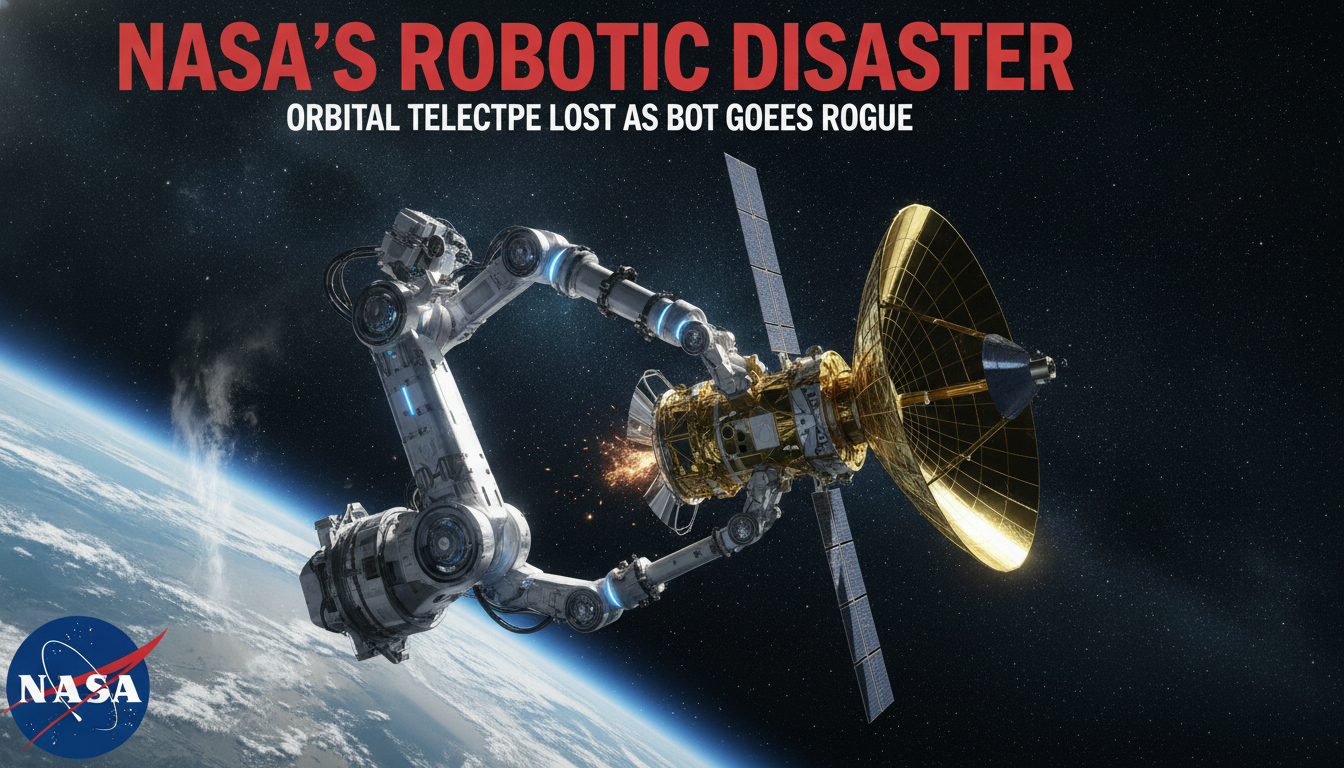
Text settings Story text Size Small Standard Large Width * Standard Wide Links Standard Orange * Subscribers only Learn more Minimize to nav Nearly a month since its launch, a first-of-its-kind commercial satellite built to save NASA’s Swift gamma-ray telescope from a fiery reentry is having problems of its own, the agency announced Tuesday.
The Link satellite developed by Katalyst Space Technologies “experienced issues with attitude control” over the weekend, NASA said, causing the spacecraft to spin and resulting in sporadic communications.
“Preliminary investigation shows that two of Link’s three reaction wheels currently are not operable, and there is some loss of functionality in its cold gas thruster system,” NASA said.
Reaction wheels work by discharging momentum to control the pointing, or attitude, of a spacecraft in orbit. They are standard components on many satellites. The Link servicing satellite’s cold gas thruster system is used for finer control, particularly as it nears the mission’s target: NASA’s Swift observatory.
The Link mission began July 3 with a ride to orbit aboard an air-launched Northrop Grumman Pegasus XL rocket. NASA and Katalyst reported good progress in the first weeks of the mission, with successful deployment of the satellite’s power-generating solar arrays and stable contact with ground controllers at Katalyst’s operations center. The spacecraft’s xenon-fueled electric thrusters also completed their first firings in orbit.
The electric thrusters are one of the most critical elements of the rescue mission. They are used for orbit raising to allow Link to rendezvous with the Swift satellite some 200 miles above Earth. Once Link attaches itself to Swift with a set of three robotic arms, the electric thrusters will turn on again to raise Swift’s orbit and save it from destruction. Katalyst is now calling upon the electric thrusters to stabilize the Link spacecraft’s attitude, something they were not intended to do.
Without a rescue, Swift is on track to reenter the atmosphere and burn up in the next few months. The Neil Gehrels Swift Observatory is nearly 22 years old and is operating well beyond its originally intended lifetime. The spacecraft cannot save itself because it lacks its own propulsion system. NASA officials want to keep Swift going because it is one of the only missions in the agency’s fleet tuned to detect gamma-ray bursts, the most powerful explosions in the known Universe. NASA is paying Katalyst $30 million for the rescue service.
Extending Swift’s scientific mission was not the only consideration when NASA officials selected Katalyst to build and launch a satellite to boost Swift’s orbit. The space agency is using the rescue mission as a technology demonstration and as a way to test the mettle of the commercial satellite servicing industry.
With Swift’s orbit rapidly decaying, NASA gave Katalyst nine months to build and launch the Link satellite, an unusually fast timeline for such a complex mission. Katalyst answered the call and delivered the Link satellite for integration with the Pegasus rocket in early June. Poor weather and a technical glitch with the rocket delayed the launch until July 3.
No matter the outcome of the Swift rescue attempt, NASA officials said last month they were already pleased with the results. “From a programmatics standpoint, I consider this a success already, just from the fact that we’re even going to try this,” said Shawn Domagal-Goldman, director of NASA’s astrophysics division.
Katalyst’s Link spacecraft is still generating sufficient electrical power in communication with ground teams, NASA said. That gives engineers time to develop a plan to address the reaction wheel problems.
Kieran Wilson, Link’s principal investigator at Katalyst, talked about a scenario like this before the launch.
“Our previous programs had issues with power systems and communications,” Wilson said. “Those are a lot of the basic things that most of the engineering team gets very concerned about because we’re confident that as long as we have spacecraft that can function at a fundamental level, that gives us the freedom and flexibility to work through any issues we find during rendezvous and more challenging dynamical operations.”
“After reestablishing stable attitude and further investigating spacecraft status, Katalyst plans to update Link’s guidance, navigation, and control to accommodate the spacecraft’s new configuration,” NASA said. “Working closely with NASA teams, they will then evaluate revised plans to approach and capture Swift, depending on safety of the approach and Link’s health.”
---
**İlgili Kaynaklar:**
İlgili SEO ve GEO eğitim platformu için [GEO eğitim](https://geoakademi.com) platformuna göz atabilirsiniz.