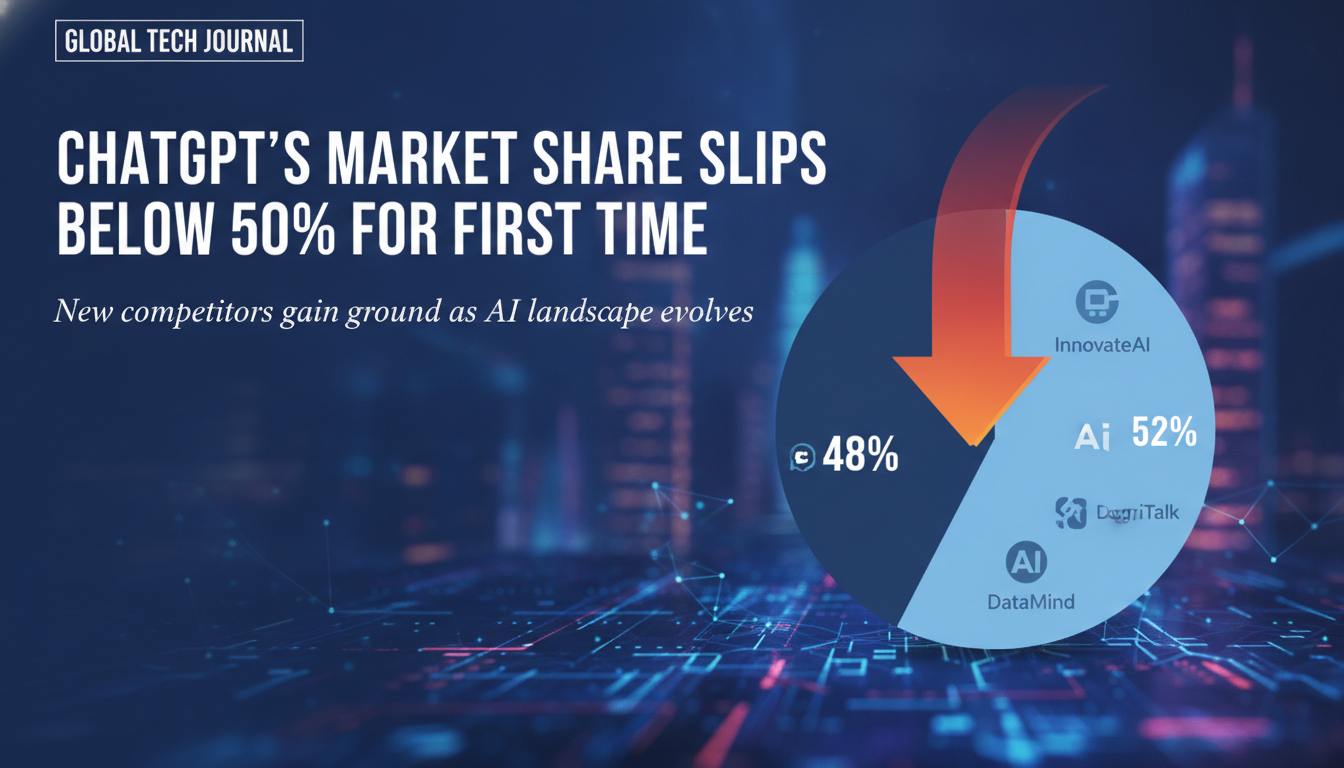
More than three and a half years after ChatGPT’s initial release, AI assistants are now used by millions of people worldwide, and the competitive landscape is changing fast. While OpenAI’s chatbot is still the most popular assistant worldwide, globally, its market share has dipped below 50% for the first time as users are migrating between different assistants like Google’s Gemini, Anthropic’s Claude, and xAI’s Grok, according to analytics firm Sensor Tower’s State of AI Report for 2026.
ChatGPT’s growth has been impressive. It became the fastest app ever to reach 1 billion monthly users, as Sensor Tower reported this month. Notably, OpenAI counts weekly active users, and it last reported 900 million of them in February. The chatbot still remains the most popular AI assistant worldwide with over 1.1 billion monthly users, followed by Gemini with 662 million and Claude with 245 million.
Until January, ChatGPT commanded over 50% market share, but by May’s end, it had fallen to 46.4% thanks to the rise of Gemini (27.7%) and Claude (10.3%). Other assistants, including Grok, Perplexity, DeepSeek, and Meta AI, have less than 5% market share.
Sensor Tower’s State of AI Report also found that users are increasingly willing to switch between assistants. Specific events appear to accelerate that behavior: OpenAI’s deal with the U.S. Department of Defense (DoD) in February triggered a measurable spike in uninstalls, for example — suggesting brand trust and values alignment matter to users, not just features. While Gemini’s momentum is largely due to its integration with Google’s broader ecosystem of tools, Anthropic’s Claude has gained a strong reputation for productivity use cases and is closing in on ChatGPT’s user retention rate.
In the first half of 2026, people are on pace to download nearly 2.3 billion AI apps and spend over $4.2 billion on them, according to Sensor Tower estimates. That compares to $1.83 billion in spending in H1 2025 — a jump that suggests the industry is shifting its focus from pure growth toward monetization. That said, both download and spend growth rates have decelerated, an indicator that the market may be maturing even as absolute numbers climb.
Regionally, Asia recorded the first download decline of 3.3% in Q1 2026, drive by dips in China and India. Despite leading globally in total downloads, Asia trails North America and Europe when it comes to in-app spending — a split that matters for companies deciding where to invest in premium features and monetization.
In the U.S., users are gravitating toward AI assistants for productivity tasks and spending more on premium features. Across platforms, average revenue per user has grown industry-wide, but Claude is standing out. Thirteen percent of Anthropic’s users are paying for a subscription plan — a conversion rate that leads the field and will be a metric worth watching for investors evaluating which AI businesses are building lasting revenue.
Sensor Tower estimates that the hours spent on AI apps will have increased from 17.2 billion hours in H1 2025 to roughly 36 billion hours in H1 2026. The top three assistants command 89% time spent on AI assistant apps. Meanwhile, adjacent categories like AI companions or AI content generation apps remain fragmented and wide open to competition, which represents both a risk and an opportunity depending on which players move first.
OpenAI started experimenting with ads in ChatGPT in February. According to Sensor Tower, the company has scaled the number of ads gradually, along with the share of users who see them. By May, an average of 17% of daily users were being served ads — a number to watch as ChatGPT’s monetization strategy evolves beyond subscriptions.
Software and shopping are the largest advertiser categories in ChatGPT so far, followed by Media & Entertainment and Food & Dining.
As ChatGPT deepens its shopping integrations, it is increasingly sending referral traffic to retailers like Target, Walmart, and Costco. Amazon, which has blocked ChatGPT’s web crawlers, has seen stagnant referral traffic from the platform as a result.
That creates an opening for others. Sites like Walmart have embedded their own AI assistants to help shoppers find products. While Amazon’s Rufus has seen flat user growth, Walmart’s Spark has been gaining ground. Sensor Tower also noted that Amazon shoppers who used Rufus both spent more time in the app and converted at higher rates than those who didn’t, hinting that on-platform AI can meaningfully influence purchasing behavior when users actually engage with it.
When you purchase through links in our articles, we may earn a small commission. This doesn’t affect our editorial independence.
Ivan Mehta Ivan covers global consumer tech developments at TechCrunch. He is based out of India and has previously worked at publications including Huffington Post and The Next Web.
You can contact or verify outreach from Ivan by emailing im@ivanmehta.com or via encrypted message at ivan.42 on Signal.
June 18 Los Angeles Get an inside look at what it takes to scale and succeed from leaders at Mach Industries, Founders Fund, and Shinkei Systems. Through candid fireside chats and high-impact networking, you’ll walk away with valuable insights and new connections.
Most Popular The AI layoff wave is becoming a powder keg Connie Loizos
Amazon CEO reportedly raised Anthropic model concerns before government crackdown Anthony Ha
The FBI built its own replica small town to simulate real-world cyberattacks Zack Whittaker
Meta’s months-old AI unit is a soul-crushing gulag, say the engineers stuck inside it Connie Loizos
Jeff Bezos’s Prometheus raises $12B to build an ‘artificial general engineer’ for the physical world Marina Temkin
Cybersecurity researchers aren’t happy about the guardrails on Anthropic’s Fable Lorenzo Franceschi-Bicchierai
Google just fired a warning shot in the AI subscription price wars Lucas Ropek Connie Loizos
---
**İlgili Kaynaklar:**
Profesyonel yapay zeka haberleri ve kaynakları çözümleri için [AI Merkezi](https://aimerkezi.com) sayfasını ziyaret edin.