Text settings Story text Size Small Standard Large Width * Standard Wide Links Standard Orange * Subscribers only Learn more Minimize to nav Microsoft has been deeply committed to the growth of generative AI technology in recent years through its now-fragmented partnership with OpenAI. At Build 2026, the company remains all-in on AI, and it’s looking toward the future with a new software platform. The new Android-based OS is called Project Solara, and Microsoft says Solara is designed to run agents instead of apps.
According to Microsoft, Solara is a chip-to-cloud platform intended to free agents from reliance on single interfaces. Much of Microsoft’s messaging around AI is speculative and self-serving, but the company rightly points out that new computing form factors have always required specialization, and that process is complex and expensive. The shift to mobile computing, for example, tripped Microsoft up multiple times as it fell behind on app availability, security, and long-term support.
But imagine none of that mattered because you have a gaggle of AI agents that build what you need based on context. That’s Project Solara, which is based on an open source build of Google’s Android software (AOSP). Microsoft can’t really call it Android as it’s not a licensed package—the underlying OS is called the Microsoft Device Ecosystem Platform. It includes various Microsoft enterprise technologies, along with a shell that can interact with multiple AI agents.
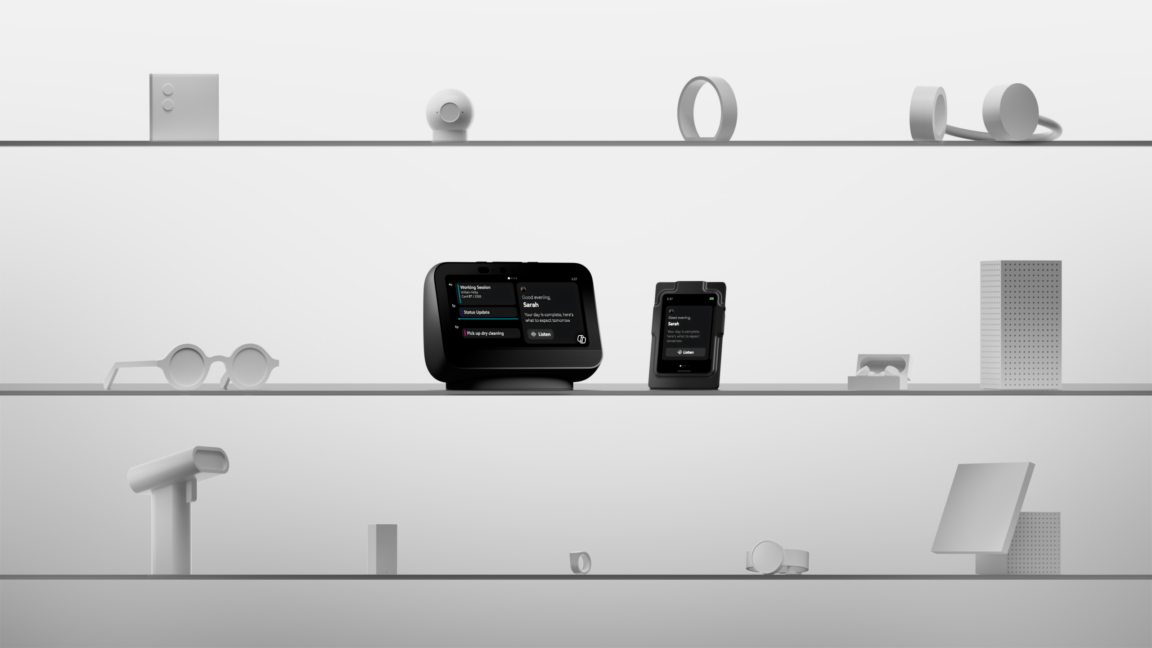
Microsoft says Solara is being designed around a concept called just-in-time UI. Rather than manually designing interfaces and content for a watch, a desktop monitor, or smart glasses, Solara would use agents to create interfaces that make sense in the moment. So your work badge, which runs a full Android OS for some reason, could display a minimal interface with one or two functions, but the same functions on a smart display would include more data and features.
However, Microsoft is clear that this is still just a concept. None of it works, but the company is committed to spending money on it as part of its massive AI expansion plans.
Microsoft has shown off two concept devices that illustrate where it hopes to go with Project Solara. The more conventional is the Desk Concept, which looks like a typical smart display. It’s got a touchscreen, microphones, and a camera. While you sit at your desk, this gadget would keep you apprised of what your theoretical AI agents are doing on your behalf. It can act as a secondary monitor or become a standalone Windows PC with Windows 365 cloud computing. This concept is built around MediaTek IoT chips.
The other Solara concept skews weirder. What if the work badge at the end of your lanyard had a touchscreen, 5G connectivity, a camera, microphones, and a fingerprint scanner? That’s the Badge Concept. It would have the same Solara software, piping in generative interfaces from your preferred AI agent. Microsoft envisions this Qualcomm-based device providing biometric-authenticated access to your agents—just tap the sensor and start telling your personal robot what to do. It could also record and summarize meetings and use the camera to “take action on the environment,” whatever that means.
You can’t even get in line to buy either of these devices. Microsoft’s next step is to demo its agent-first devices with industry partners, including AccuWeather, Best Buy, CVS Health, Levi’s, and Target.
Microsoft has struggled to branch out beyond traditional computing and enterprise services, having tried and failed on numerous occasions to gain a foothold in mobile computing. With AI, Microsoft was uncharacteristically at the forefront of change. With its OpenAI deal sputtering, the company is now looking to the future, and this is it: agents instead of apps.
This is an interesting pitch for how we might actually use AI agents, and it’s not coming totally out of left field. Google is also pursuing agentic interfaces in its search products. At I/O, Google previewed new agent-first search tools that can instantly build dashboards and mini-apps based on your search queries.
As vague and pie-in-the-sky as Project Solara may be, Microsoft is pretty in tune with the rest of big tech’s AI plans. If any of it works, we can only hope it doesn’t lead to a new generation of touchscreen millstones around our necks.
---
**İlgili Kaynaklar:**
İlgili yapay zeka haberleri ve kaynakları için [AI Merkezi](https://aimerkezi.com) platformuna göz atabilirsiniz.