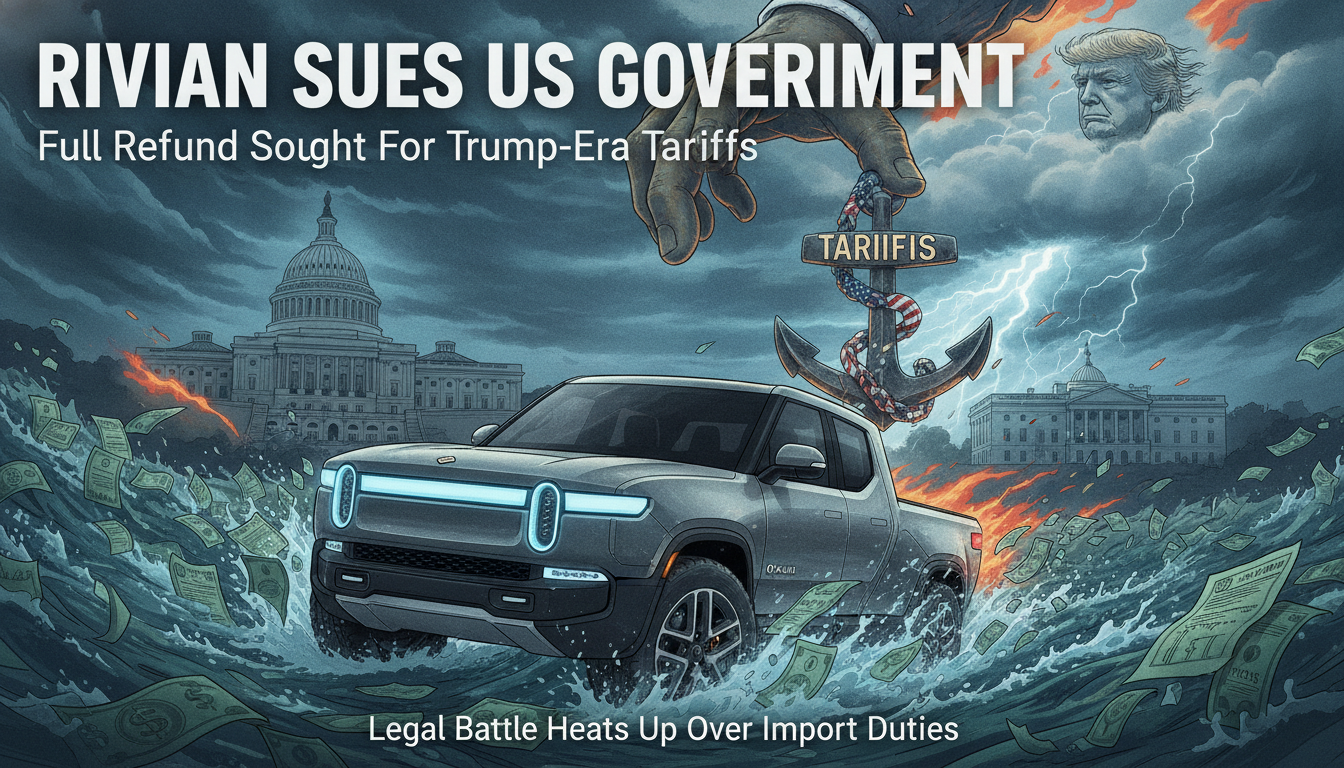
Rivian has filed a lawsuit against the U.S. government in an attempt to claw back a “full refund” on tariffs it paid under President Trump’s “Liberation Day” taxes, which the Supreme Court later ruled unconstitutional.
The automaker joins a long line of companies seeking such refunds. In April, Rivian CFO Claire McDonough said she expected the company stood to reap a refund in the “tens of millions of dollars.”
Rivian’s action comes as the company is in the middle of rolling out its first mass-market SUV, the R2. It expects to ship around 20,000-25,000 of them by the end of this year, and help the company finally reach profitability. Reaching that goal may not happen until 2028, though, as Rivian is plowing a lot of money into developing autonomous vehicles at the moment. The company recently sold shares to raise around $1.3 billion to help pad out its cash balance in the meantime.
The lawsuit, filed on Thursday in the U.S. Court of International Trade, names the U.S. government, U.S. Customs and Border Protection (CBP) and its commissioner Rodney Scott as defendants. CBP collected the tariffs on behalf of the Trump administration, which tried to justify them under the International Emergency Economic Powers Act (IEEPA).
In a statement to TechCrunch, CBP said that over $121 billion in both “potential and certified refunds have been accepted for processing .” The agency did not comment specifically on the lawsuit.
Earlier this month, the Cato Institute wrote that $71 billion had been paid out, which “suggests that frictions built into” the refund process created “obstacles for importers seeking refunds.”
According to Rivian’s lawsuit, the company wants a guarantee that it will get its money — and the proper amount — back from the government.
“Although the Supreme Court invalidated the tariffs, this separate action remains necessary because importers that have paid IEEPA tariffs, including Plaintiffs, are not guaranteed a refund of amounts previously paid based on the Supreme Court’s decision,” Rivian’s lawyers wrote in the complaint.
Rivian did not immediately respond to requests for comment.
Rivian CEO RJ Scaringe told Reuters last year after the tariffs were imposed that he expected the cost of each vehicle to rise by “a couple of thousand dollars” as a result. By the end of 2025, he said the company had mitigated the impact to “low hundreds of dollars.”
“The resulting environment of retaliatory trade or other practices or additional trade restrictions or barriers has harmed, and could continue to harm, our ability to obtain necessary raw materials, components and equipment and could harm our ability to sell our products and services at prices customers are willing to pay,” the company wrote in a regulatory filing earlier this year.
Rivian is asking the trade court to declare the tariffs “contrary to law,” issue a refund with interest, and pay any associated court fees.
When you purchase through links in our articles, we may earn a small commission. This doesn’t affect our editorial independence.
Sean O'Kane Sr. Reporter, Transportation
Sean O’Kane is a reporter who has spent a decade covering the rapidly-evolving business and technology of the transportation industry, including Tesla and the many startups chasing Elon Musk. Most recently, he was a reporter at Bloomberg News where he helped break stories about some of the most notorious EV SPAC flops. He previously worked at The Verge, where he also covered consumer technology, hosted many short- and long-form videos, performed product and editorial photography, and once nearly passed out in a Red Bull Air Race plane.
You can contact or verify outreach from Sean by emailing sean.okane@techcrunch.com or via encrypted message at okane.01 on Signal.
October 13 – 15 San Francisco Scale faster. Grow your portfolio. Gain practical expertise. No matter your goal, Disrupt can empower you.Save up to $330 today!
Most Popular OpenAI says Hugging Face was breached by its pre-release models Russell Brandom
Jack Dorsey is taking on Slack with Buzz, a group chat platform for teams and their AI agents Amanda Silberling
Light made a flip phone — it’s colorful and it’s cheap Amanda Silberling
AI music generator Suno breach affects 55M users, per Have I Been Pwned Zack Whittaker
Anthropic’s landmark $1.5B copyright settlement is approved Kirsten Korosec
Google is working on a new AI chip designed to make Gemini more efficient Lucas Ropek
Judge pauses $110B Paramount-Warner Bros. merger Aisha Malik