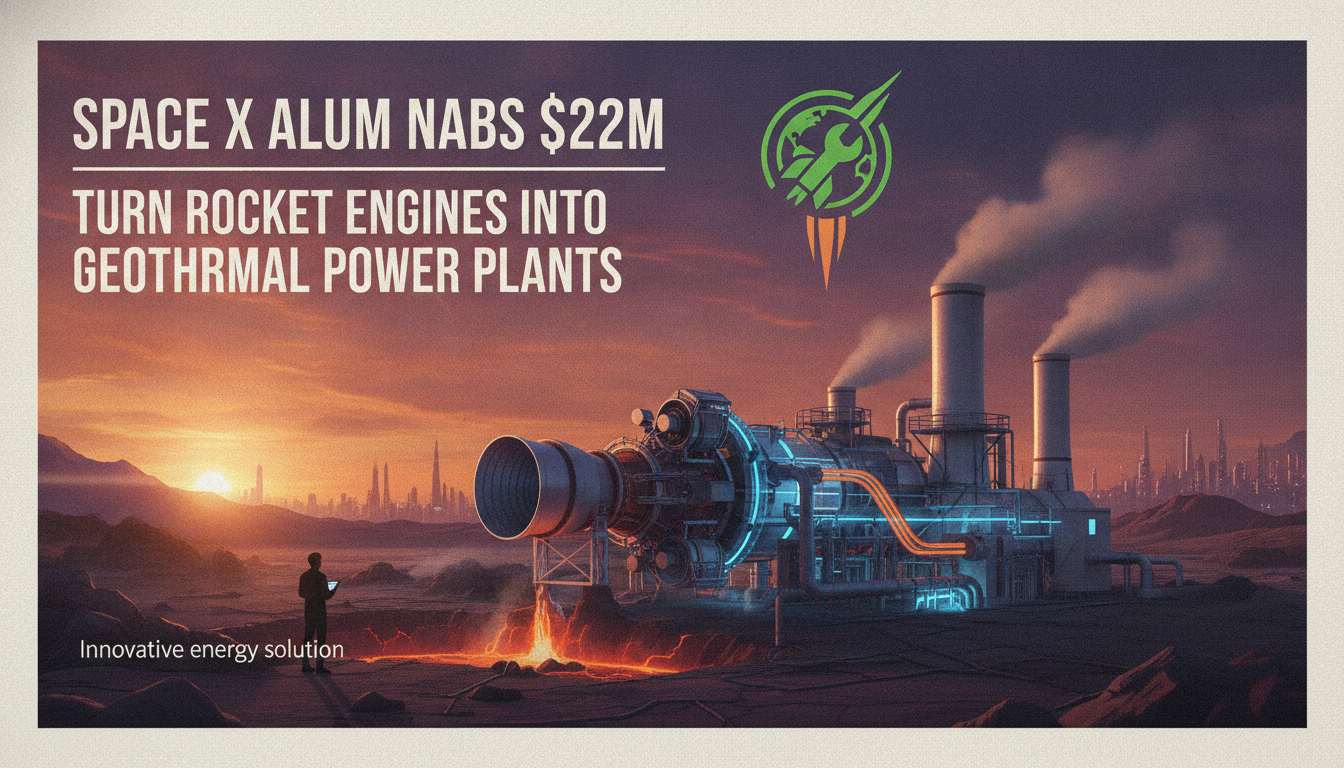
Few energy sources can top geothermal’s potential, with at least 42 terawatts of capacity available worldwide, according to the IEA, more than twice the world’s energy use last year.
The technology is shaping up to be the energy world’s dark horse, even though investment in the tech pales in comparison to startups in advanced nuclear fission and fusion power.
That makes the $19 million in seed funding raised by a startup called Critical Energy especially notable. Critical Energy hopes to fill a major gap for geothermal power plants by building modular turbines tailored to them. The funds are earmarked to build its first 2.5 megawatt project, the startup exclusively told TechCrunch.
Meanwhile the darlings of the investment world, those working on nuclear fission and fusion, are targeting the early 2030s for their first commercial deployments. By that time, geothermal startups could be building gigawatt-scale power plants.
“Geothermal is going to beat them to it. By a lot,” Spencer Jackson, co-founder and CEO of Critical Energy, told TechCrunch. “In four or five years, I hope that we’re doing many gigawatts a year.”
Even modest expansion of geothermal could pay off to serve the world’s — and especially the tech industry’s — growing energy needs. A recent report said that advanced geothermal could power nearly two-thirds of new data centers by 2030.
But Jackson said there’s a looming shortage of compatible turbines. Many projects today are specifying large turbines, which can take months to years to assemble on site, he said. “It’s still way faster and cheaper to make it the other direction, to built it in a factory.”
Critical Energy hopes to fill the gap with modular turbines. To design them, Jackson leaned on his experience at SpaceX, where he worked on Falcon Heavy, Starship, and the Raptor rocket engine. To build them quickly, Critical Energy is working with machine shops to make the turbomachinery and other turbine components, which resemble rocket engines. It’s buying other parts off the shelf for now. In the future, the startup may decide to bring other pieces in house, similar to how Tesla and SpaceX have done, Jackson said.
The first power plant to use Critical Energy’s turbines is scheduled to be completed by 2027 and will be installed at an existing geothermal site similar to those found in Iceland or at The Geysers in Northern California. Critical Energy is also designing a larger, 5 megawatt module targeted at enhanced geothermal companies like Fervo Energy, which drill deeper into the Earth to withdraw more heat.
By the early 2030s, Jackson hopes Critical Energy will be making gigawatts worth of turbines. “We are looking for the fastest path to gigawatts of scalable power on the grid,” he said. “Long term goal is 300 gigawatts a year in 2045.”
Though geothermal development has been quietly proceeding, Jackson expects that once the technology is more mature, oil and gas companies will dive in, speeding things up considerably.
“Geothermal is great because the oil and gas industry has the replicability to do hundreds and then thousand of wells. They’re very, very good at drilling wells,” he said. “But they need turbines and there’s going to be a massive shortage of those.”
The seed rounds were led by Susa Ventures and Upfront Ventures with participation from MaC Venture Capital, Susquehanna Sustainable Investments, Humba Ventures, Scribble Ventures, and Underground Ventures. The startup also nabbed $3 million in venture debt from Silicon Valley Bank bringing its total early capital to $22 million.
When you purchase through links in our articles, we may earn a small commission. This doesn’t affect our editorial independence.
Tim De Chant is a senior climate reporter at TechCrunch. He has written for a wide range of publications, including Wired magazine, the Chicago Tribune, Ars Technica, The Wire China, and NOVA Next, where he was founding editor.
De Chant is also a lecturer in MIT’s Graduate Program in Science Writing, and he was awarded a Knight Science Journalism Fellowship at MIT in 2018, during which time he studied climate technologies and explored new business models for journalism. He received his PhD in environmental science, policy, and management from the University of California, Berkeley, and his BA degree in environmental studies, English, and biology from St. Olaf College.
You can contact or verify outreach from Tim by emailing tim.dechant@techcrunch.com.
June 18 Los Angeles Get an inside look at what it takes to scale and succeed from leaders at Mach Industries, Founders Fund, and Shinkei Systems. Through candid fireside chats and high-impact networking, you’ll walk away with valuable insights and new connections.
Most Popular SpaceX to acquire Cursor for $60B in stock, days after blockbuster IPO Sean O'Kane
The US government’s Anthropic models ban was never about an AI jailbreak Zack Whittaker
The AI layoff wave is becoming a powder keg Connie Loizos
Amazon CEO reportedly raised Anthropic model concerns before government crackdown Anthony Ha
The FBI built its own replica small town to simulate real-world cyberattacks Zack Whittaker
Meta’s months-old AI unit is a soul-crushing gulag, say the engineers stuck inside it Connie Loizos
Jeff Bezos’s Prometheus raises $12B to build an ‘artificial general engineer’ for the physical world Marina Temkin
---
**İlgili Kaynaklar:**
Detaylı AI destekli reklam ve pazarlama çözümleri için [yapay zeka reklamcılığı](https://yapayzekareklami.com) sayfasını incelemenizi öneriyoruz.